

By Adebayo Adenrele
To a layman, a prison is a condemned, fragmented wall designed for individuals who have been forsaken by society, regardless of the magnitude of the offence that threw them under the bus.
Once convicted, he is forced to bear ‘Elewon’ (prisoner) as his first name, whom society stigmatizes, believing that nothing good can ever come out of him anymore.
In fact, despite the change from being called a prison to the Nigerian Correctional Service (NCoS) on August 15, 2019, by former President, Late Muhammadu Buhari, society rather ignores its rehabilitation and reintegration focus but prefer to profile them.
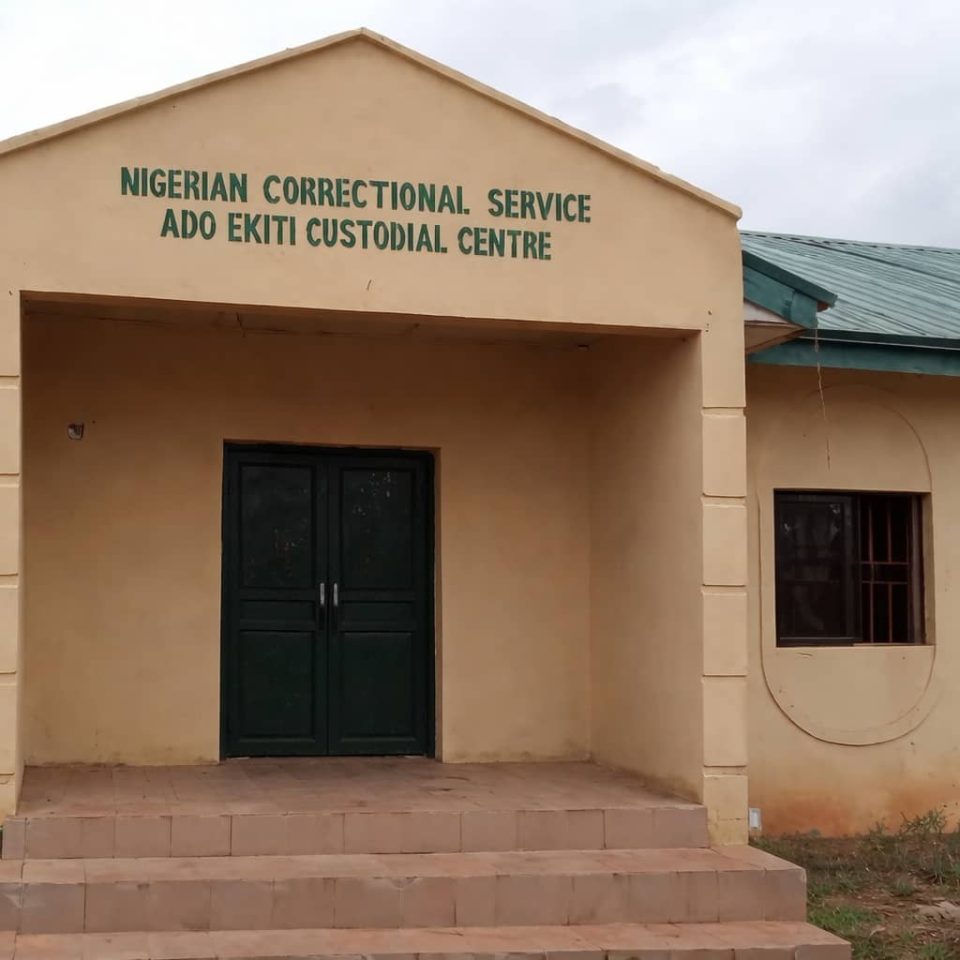
During a visit to the Ekiti State Correctional Centre, the atmosphere was nothing but a completely different world, the inhabitants looked at visitors like strangers intruding into a place they have already turned into a home.
The expressions on many of the faces encountered was fading hope and failure of the correctional facility to live up to its mandate but treat inmates as subhumans, abandoned to their fate.
Narrating his ordeal, one inmate in his late 30s (name withheld) said he was implicated by his wife, who had a provision store but was secretly selling illicit drugs to buyers.
He claimed to have warned her, informed her family members and even left home because of her, but was eventually arrested by officials of the National Drug Law Enforcement Agency (NDLEA) the day he returned home because they could not find his wife.
He said he was taken to court and paid over N450,000 as legal fees, but later suspected a conspiracy among his family members who did not want him to leave the Correctional Centre because of the fortune they were getting from his cocoa farm.
Another inmate in his late 20s claimed that the police traced a phone to his house, which he alleged was dropped in his room and he was arrested and incarcerated because he could not afford a N10,000 bail.
Another inmate in his late 30s said he was implicated by a then 17-year-old girl, now 19, who accused him of rape.
According to him, the girl claimed she was raped in his sitting room when she came to charge her phone, while his wife tied her down so that he could have carnal knowledge of her.
He alleged that the girl’s father was into cultism and had persuaded him to join them, but he refused; hence, the setup.
It is noteworthy to say that males are not the only individuals either remanded or serving jail terms, as their female counterparts, although few, have their own stories to tell.
A lady in her mid-20s, who was brought to the Correctional Centre with a seven-month pregnancy, said she was implicated by her boyfriend, who was selling illicit drugs.
According to her, they were both arrested and she was charged with conspiracy while she gave birth at the Correctional Centre and still has almost two years to serve.
Another lady in her late 30s claimed to be the wife of a herbalist who used her bank account to receive money made from fraudulent activities.According to her, they were traced, arrested and charged by the court for fraud.
Another lady in her early 20s, who was remanded in 2019, said she was just convicted in 2025 and would spend an additional 15 years at the Correctional Centre.
According to her, her lover was involved in a murder case, but she did not inform anyone, which led to his arrest, while she was also charged with conspiracy.
The Muslim Chaplain of the correctional centre, Dr. Balogun Badrudeen Adesina, said that correctional facilities were formerly known as prisons because they were primarily designed to punish offenders, but the system has evolved into a more reform-focused institution.
He said the centre provides opportunities for inmates to reflect on their actions, seek forgiveness and undergo rehabilitation before being reintegrated into society.
According to him, the correctional system also operates an aftercare programme that monitors and guides former inmates after their release to ensure they successfully reintegrate into their communities.
Adesina further disclosed that the Ekiti custodial centre currently houses close to 900 inmates with varying offences, noting that the nature of crimes has evolved over time.
His words, “A correctional centre is another term entirely that defines a set of people living in a system quite different from what is obtainable in the outside world. This is my first time here, and I didn’t really know how things were. As I’m speaking, I pray I do not get emotional.
“This is a correctional custodial centre. Originally, it was called a prison. Based on the situation then, it was designed to punish, but now it is a custodial centre. That is why the name was changed from Prison Service to Correctional Service. For every offence or crime, there is a moment of reflection, where one can seek forgiveness and do away with wrongdoing.
“As a result, we have realised that punishment is not the main issue. The major focus is how to correct these individuals so they can behave better, reform them, and reintegrate them back into society. Even after that, we still provide aftercare services.
“You see, some people come and others go, but by the time they return to their respective societies, we still follow up with them, advise them, and provide necessary assistance so they do not return to the offences they committed before coming here.
“In terms of experiences, we are in a different world here. Some years back, offences like kidnapping and internet fraud were not as rampant as they are today. But these days, you may see cases where someone has taken another person’s life.
“At the end of the day, such individuals may still attribute their actions to external forces. We currently have close to 900 inmates with different offences. You can hardly find two cases that are exactly the same.
“They can be classified in different ways, but when they come to you to tell their stories, you will realise that each has a different version”.
The few voices within the four walls of Ekiti Correctional Centre, are reflections of many untold stories that the society has not yet heard but the fact remains that justice must be served and no offender shall go unpunished.