

Adebayo Adenrele
The Nigerian Institute of Quantity Surveyors (NIQS), Ekiti State Chapter has held its 2026 Distinguished Guest Lecture titled: “Public-Private Partnership for Sustainable Infrastructure Development: Stakeholders’ Engagement”, aimed at supporting development initiatives under Public-Private Partnership (PPP) frameworks for a better infrastructural society.
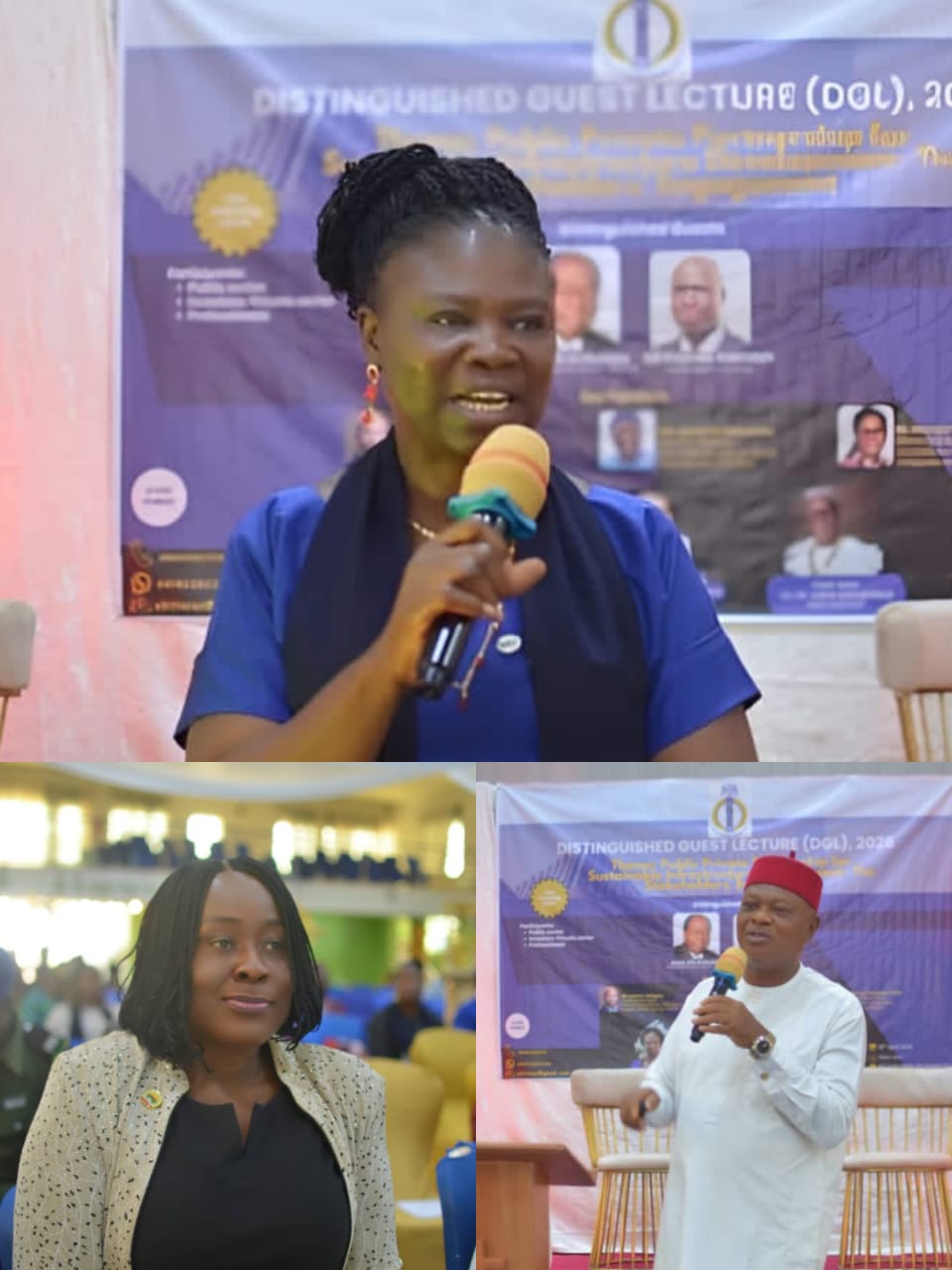
Speaking during its 2026 Distinguished Guest Lecture titled “ the State Chairman of the Institute, Dr. Olubunmi Ade-Ojo stressed the importance of collaboration, transparency and public understanding in ensuring the success of Public-Private Partnership (PPP) projects aimed at improving infrastructure and service delivery.
Dr. Ade-Ojo explained that infrastructure projects are not designed to benefit individuals but to serve the wider population, noting that PPP arrangements allow the private sector to provide financial resources and expertise to deliver essential infrastructure on behalf of government.
According to her, successful PPP projects require synergy among all stakeholders, including government, private investors and end users.
Her words, “Projects are not meant for individuals. Projects are meant to serve a wide array of the populace provided by the government.
“Now, when you have a PPP arrangement, it involves the private sector bringing its financial resources to provide these infrastructure facilities on behalf of the government to the people.
“For a PPP project to be successful, all the stakeholders must be on the same page. They must be in agreement. It is not enough for the government and the private sector to agree while the end users or the public are not in agreement.
“For a successful PPP, there must be synergy. Everybody must be brought to the table and must agree that we want this project. If not, the project can start and it will be frustrated. That is why we are here.
“That is why we call it the meeting point bringing stakeholders to the table. Everybody should go home with an understanding of how a PPP project should run, the benefits and the challenges. When you understand the challenges you are likely to face, you are able to navigate the difficult areas.
“Also, when you understand the benefits, you are able to make informed decisions to know that instead of suffering from a lack of some facilities, the services of a private individual or organization can be engaged.
“It also provides opportunities to educate the public sector. We have many participants from different ministries and parastatals here. I believe with this lecture they now have a better understanding of what PPP projects stand for and what the government stands to gain from employing this means of project financing”.
In her remarks, the Head of Service in Ekiti State, Dr. Folakemi Olomojobi, described bureaucracy as a structured system for delivering results, emphasising that effective governance requires clear processes and collaboration.
She commended the leadership of Ekiti State for demonstrating strong political will in promoting partnerships that drive development and improve the ease of doing business in the state.
According to her, Ekiti State enacted its Public-Private Partnership law as far back as 2011 and later re-enacted it in 2020 to address identified gaps and strengthen the framework for private sector participation in development.
“Bureaucracy is just a system of doing things. Bureaucracy means that you have a system of performing, and its target is to deliver results.
“In Ekiti State, I must commend the leadership of the state, the governors, the present governor, and past governors because we can see massive political will to get results in doing business in the state.
“As far back as 2011, Ekiti State had the Public-Private Partnership law, which was re-enacted in 2020 to accommodate areas of gaps. We understood our strengths as a state and realized that we needed private partnership to deliver results for our people.
“If we are going to run budgets, we start from the grassroots level. In that engagement, we listen to the people, we hear what they need, and we determine how we are going to address it.
“For example, if people say there is no water, the government can say we are not businessmen and women, but we can partner with private investors to ensure that water is provided. The people, the consumers, the public service and the political class agree on how it will be done.
“That is what has given birth to many innovations we are seeing in the water sector, the hospital sector, infrastructure, and even the hospitality business. We sat down to engage.
“I must confess that it comes from engaging and engaging continuously. Today we have a work plan on the ease of doing business and Ekiti has presented it at this conference”. She added
In his lecture, Dr. C.C Katchy emphasised the need for governments to provide access to affordable financing to support development initiatives under PPP arrangements.
He noted that when governments can access funds at low interest rates, such as about two percent, such resources should be channelled into development projects rather than remaining idle.
According to him, high lending rates can discourage investment in critical infrastructure projects, making government support necessary to ensure that financing remains accessible and sustainable.
He also stressed the importance of public awareness and transparency in PPP arrangements, noting that clear communication helps citizens understand how such projects work and enables investors to assess whether projects are financially viable.