
Adebayo Adenrele
An international election observer group under the auspices of the International Association of World Peace Advocates (IAWPA), has called on the Independent National Electoral Commission (INEC) to reconcile discrepancies in the population figures referenced for the 2022 Osun gubernatorial poll and the 2026 governorship election scheduled for Saturday, 15th August, 2026.
The group raised the concern ahead of Saturday’s governorship election, noting that the population reference figure used for the 2022 election was 3,423,535, while the figure published for the 2026 election stands at 3,415,959, despite both figures being based on the 2006 population census.
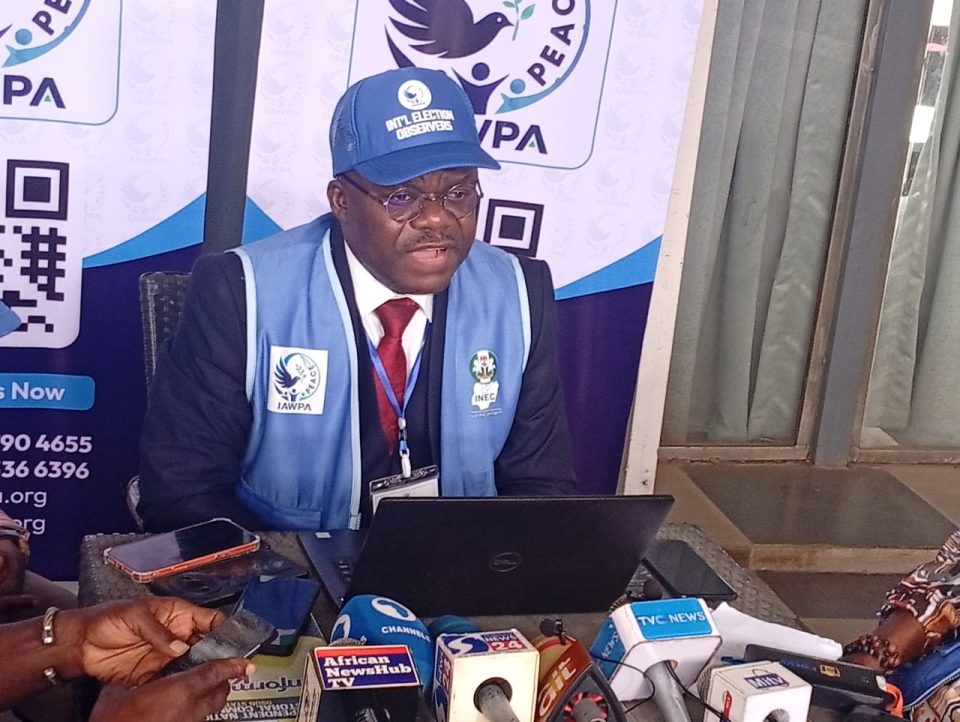
Speaking at a pre-election press conference in Osogbo, Osun State, the World Peace Spokesperson for the International Association of World Peace Advocates, Ambassador Emmanuel Nkweke, said the apparent decline in the population figure required clarification from the electoral commission.
Nkweke urged INEC to properly reconcile the figures to ensure the integrity and credibility of data being used for the electoral process.
Thr Spokesman stressed that accurate population data was important to the organisation’s observation process, particularly as the figures formed part of the secondary data being relied upon in assessing the election.
The observer said the organisation’s mission was to support the Nigerian government in achieving a peaceful, free, fair and transparent election, adding that its observers would cover the 30 local government areas of Osun State.
His words, “Our mission is very clear. It is to support the Nigerian government in achieving a peaceful, free, fair and transparent election in the state.
“Fortunately, our team of election observers will cover the 30 local government areas of the state, plus one council in Osun State.
“On the other hand, statistically, based on our arrival, we have been able to gather some vital information that will aid our observation from tomorrow through the conclusion of the election.
“We have gathered the following information: The election will indeed hold on Saturday, August 15, 2026. There is no going back. The stage is already set, with a lot of activities taking place.
“A total of 2,339,233 voters have been registered for the election, while a total of 1,906,390 Permanent Voter Cards (PVCs) have so far been collected.
“The Nigerian Police have deployed a total of 15,000 policemen to cover the election, while the Nigeria Security and Civil Defence Corps (NSCDC) has also deployed 10,000 personnel and 100 operational vehicles, all in their bid to ensure that we have a free and fair election.
“A total of 15 registered political parties are involved in the election coming up on August 15. On the other hand, as international election observers, the issue of the Bimodal Voter Accreditation System (BVAS) is a serious concern to us, based on previous experiences with the malfunctioning of BVAS and the management of election result sheets, which altogether remain a major concern to our association.
“In view of our pre-election observations and the projects presently on ground, we can categorically state that INEC is prepared for the election.
“However, there is a preliminary observation regarding the population figures published for the election, as there appears to be a difference between the population reference figures used for the 2022 election and those for the 2026 election, despite both being based on the same 2006 population census.
“The figure used for the 2022 election was 3,423,535, while the population reference figure for the 2026 election is 3,415,959.
“As international observers, we observed a decline in the figure while the same 2006 population record is being used.
“At this point, we are using this opportunity to call on INEC to ensure that the figures are corrected and reconciled. The difference between the figures referenced for the 2022 and 2026 elections, despite the use of the same 2006 population record, needs to be properly addressed”.