
Adebayo Adenrele
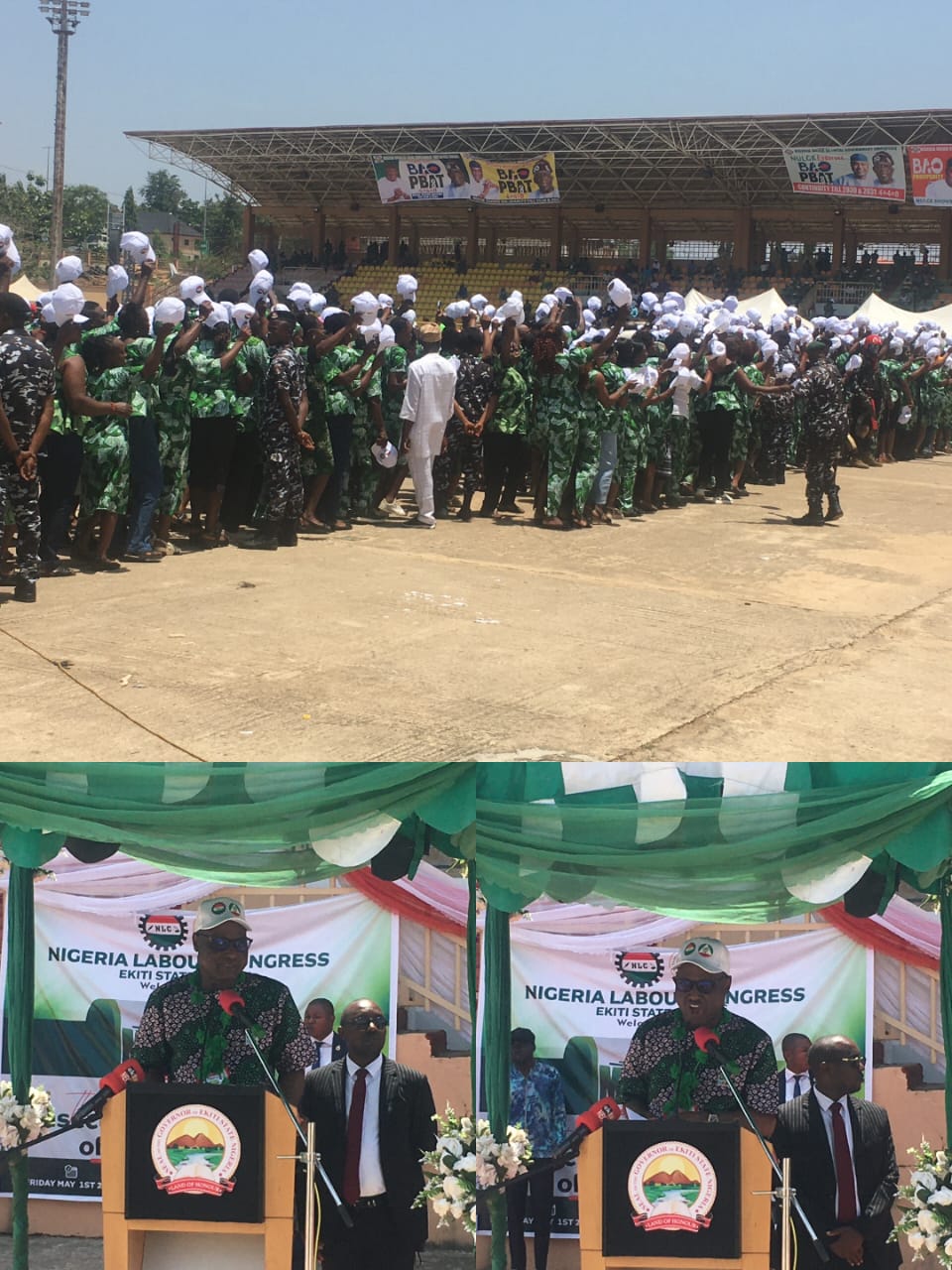
The Governor of Ekiti State, Biodun Oyebanji has pledged that his administration will continue to prioritise workers’ welfare, with a vow to sweep reforms, improve remuneration and sustain industrial harmony.
Speaking in Ado-Ekiti during the celebration of 2026 Workers’ Day themed: “Insecurity, Poverty-bane of decent work”, Oyebanji said his administration would continue to invest in workers through infrastructural development, security of the workplace, regular capacity development, merit-based promotions and appointments across the public service.
The Governor congratulated workers on the 2026 May Day, describing the occasion as a reminder of the enormous contributions and sacrifices the working class makes for the running of nations and the continuation of human civilisation.
He expressed appreciation for their support, including a recent solidarity visit to his office, noting that the success of his administration’s policies and programmes was largely due to workers’ dedication and commitment.
Oyebanji equally said his administration had prioritised prompt and regular payment of salaries, allowances, pensions and gratuities, stressing that no worker was owed promotion arrears.
According to him, all outstanding promotions up to 2025 had been cleared with full financial backing, among others.
Also speaking,the Ekiti State Chairman of Nigeria Labour Congress (NLC), Comrade Olatunde Kolapo, raised concerns over worsening socio-economic conditions across Nigeria, warning that rising insecurity, deepening poverty and a failing power sector are eroding the dignity of work and threatening national stability.
He described Nigeria’s security situation as dreadful and in urgent need of both structural reforms and decisive action.
According to him, the persistent wave of kidnappings, killings and banditry across all geopolitical zones has severely impacted economic activities and left citizens vulnerable.
He called on the Federal Government to move beyond ‘lip service’ and adopt practical, results-driven strategies to tackle the crisis, emphasizing the need for a comprehensive overhaul of the country’s security architecture.
Kolapo also lamented the unrelenting economic hardship facing Nigerians, noting that the situation has worsened significantly compared to the previous year.
He pointed to the sharp increase in the price of Premium Motor Spirit (PMS), which has risen to about ₦1,450 per litre in some parts of the country, triggering a cascade of rising costs in transportation and essential services.
Meanwhile, the NLC Chairman acknowledged the state government’s responsiveness to workers’ welfare demands.
He commended the state government for implementing key requests presented during the 2025 May Day celebration, including the promotion of deserving workers up to 2025.
Kolapo appealed for further action in 2026, particularly the approval of pending promotions for workers and teachers, payment of outstanding leave bonuses and settlement of gratuities.
The NLC Chair urged the governor to empower the Head of Civil Service to carry out promotion exercises seamlessly, noting that such actions would significantly boost workers’ morale and productivity.
His words, “Respected Nigerian Workers, the scaring security situation in the Country calls for remorse and spiritual intervention through rigorous prayers and security architectural restructuring that will inject new ideas into the system which will in turn bring sustainable results so as to safeguard and protect lives and properties of Innocent Nigerians.
“The daily incident of kidnapping, killings and banditry, in many parts of the country spanning all geo political zones of the country is not good for the growth of the country, many things have been badly affected by this insecurity scenario.
“This development has rendered Nigerians helpless and requires drastic approach to address the Security cankerworm spreading across the country like wildfire.
“Hundreds are being killed daily, people are being displaced, properties are destroyed, in most cases workers are affected and their dependants.
“Federal government should go beyond lip service, by way of press releases and emotionally inclined submissions that do not address the dangerous trend of the insecurity dimension the country is facing presently and daily.
“It is very unfortunate that year in year out the economic hardship in the country remains unabated. What Nigerian workers and their dependants went through last year was just like a tip of the iceberg compared to the present economic emasculation Nigerians are facing.
“The prices of premium motors spirits (PMS) has skyrocketed up to N1, 450 per litre in some parts of the country, which has negatively affected all attendants issues that are associated with fuel usage such as transportation which equally has had ripple effects on other essential services, workers are direly affected, they are now working from their hands to mouths.
“As a matter of regret, the state of power and electricity supply is not only abysmally low but also exploitative to the general populace.
“The recent public acceptance made by the Minister of power Chief Adebayo Adelabu that he has failed the Nation does not need any further explanation than to accept that non availability of steady power supply has further impoverished Nigerians in all ramifications.
“Federal government should think deeply and find lasting solution to the power problem in Nigeria so as to move the country out of economic doldrum to bouyance in terms of industrial development and encourage small scale industrialists”.
On her part, Ekiti State Chairman of Trade Union Congress (TUC), Comrade Omotola Farotimi advocated for community policing, improved protection of economic hubs such as farms and markets and quicker emergency response systems to enhance security.
On economic reforms, Farotimi called for the adoption of living wage policies, expansion of social protection programmes, improved access to credit for small businesses and skills development aligned with market demands.
She also stressed the need for stricter enforcement of labour laws to prevent worker exploitation, warning that the absence of decent work conditions could fuel further instability.