
…trains electoral officers on assistive devices, inclusive voting procedures
Adebayo Adenrele
The Independent National Electoral Commission (INEC) has intensified preparations for the 2027 general elections, training electoral officers and disability stakeholders on the effective deployment of assistive devices to enable persons with disabilities (PWDs) to vote independently and without discrimination.
The commission said the initiative was aimed at removing physical, informational and procedural barriers that have historically limited the participation of persons with disabilities in Nigeria’s electoral process.
Speaking during a sensitisation programme on disability inclusion, accessibility and electoral interventions organised by INEC in Ekiti State, a representative of the commission’s Department of Gender and Inclusivity at its headquarters in Abuja, Moji Awelewa, stressed the need to translate the commission’s inclusion policies into practical measures at polling units.
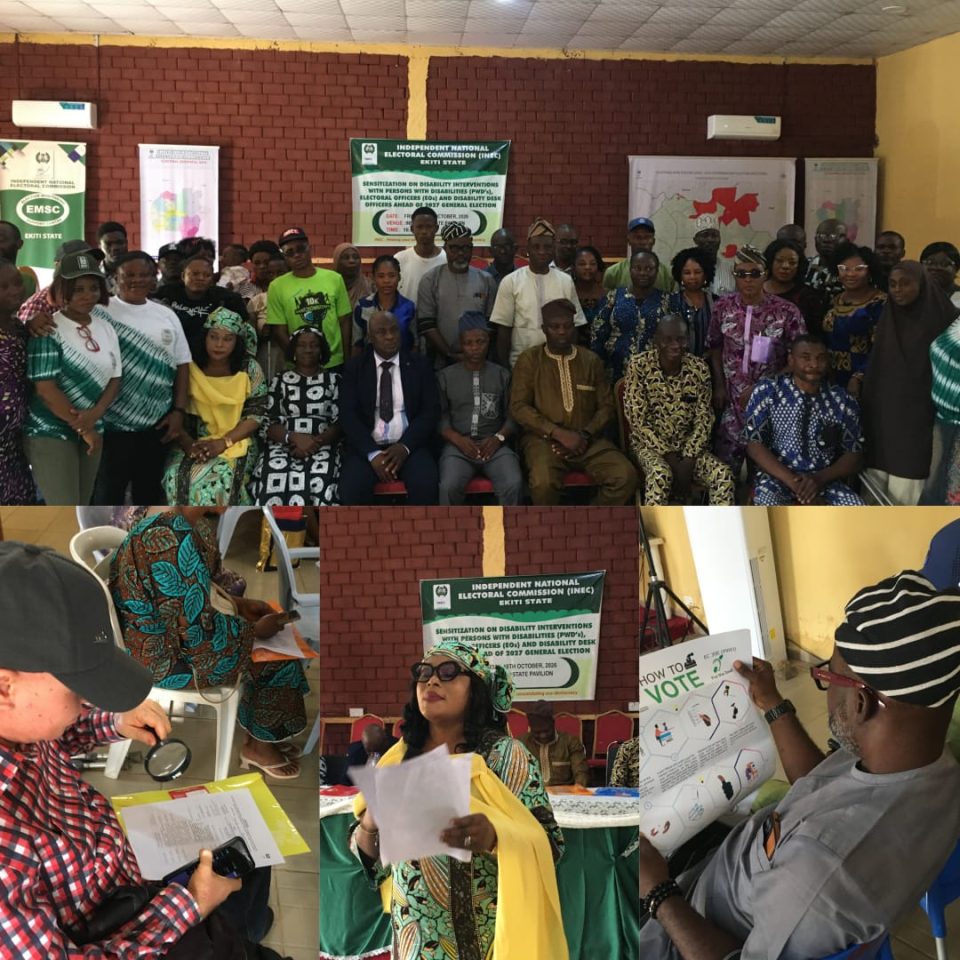
The programme brought together representatives of Organisations of Persons with Disabilities (OPDs), cluster heads, Electoral Officers (EOs) and disability desk officers to strengthen their understanding of the commission’s interventions and ensure their effective deployment ahead of the 2027 polls.
Awelewa said disability inclusion in elections was not a favour to persons with disabilities but an obligation grounded in Nigeria’s legal framework and international standards on the rights of PWDs.
She noted that the commission’s preparations were designed to ensure that every eligible voter, irrespective of physical or other disabilities, could exercise the right to vote with dignity, independence and confidence.
According to her, barriers encountered by persons with disabilities during elections have, in some instances, forced them to depend on others to cast their votes, compromised the secrecy of their ballots or excluded them from meaningful participation in the electoral process.
She said the sensitisation programme was intended to address these challenges by equipping electoral officials with the knowledge and practical skills required to identify voters’ needs and provide appropriate assistance.
Awelewa explained that accessibility extended beyond providing physical access to polling units to include access to electoral information, clear communication, usable voting materials and procedural support tailored to different categories of disabilities.
She cautioned against treating persons with disabilities as a homogeneous group, noting that voters with visual, hearing, physical, intellectual or psychosocial disabilities, as well as persons with albinism, faced different challenges requiring specific interventions.
The INEC official identified the Braille Ballot Guide, magnifying glass and EC30PWD Written Instruction Poster as key assistive materials designed to improve the voting experience of persons with disabilities.
She explained that the Braille Ballot Guide was intended to enable voters with visual impairment who could read Braille to mark their ballots independently, thereby protecting their right to vote without disclosing their choices to another person.
Where a visually impaired voter could not read Braille, she said, the voter could be assisted by a person of their choice in accordance with the commission’s electoral guidelines.
On the magnifying glass, Awelewa said the device was designed to assist voters with low vision and persons with albinism who might struggle to read fine print, including candidates’ names, party symbols and the positions of boxes on ballot papers.
She said the intervention could also help reduce wrongly marked or rejected ballots by enabling eligible voters to see ballot details more clearly before making their choices.
The EC30PWD Written Instruction Poster, she added, was designed to help voters who rely on visual information, particularly those with hearing impairment, understand the steps involved in the voting process without depending exclusively on spoken instructions.
Her words, “This engagement reflects the Commission’s deliberate movement from policy commitment to practical readiness. It affirms a shared responsibility: ensuring that every eligible voter, regardless of ability, can participate in the electoral process with dignity, independence, and confidence.
“At the foundation of this workshop lies a simple recognition disability inclusion in elections is not a favor, but an obligation rooted in law. Nigeria’s legal framework, together with international standards on the rights of persons with disabilities, requires that accessibility and support be built into the electoral process, not added as an afterthought.
“Persons with disabilities have historically encountered barriers physical, informational, and procedural that limited genuine participation in elections. These barriers have, in various forms, resulted in dependence on others to vote, compromised secrecy of the ballot, or outright exclusion from the process. This workshop exists to confront those barriers directly, ahead of 2027, through sustained engagement with OPDs, Cluster Heads, and Electoral Officers.
“Sensitization is where this work begins. Before any intervention can be effective, the personnel responsible for deploying it must understand the voter it is meant to serve their needs, the barriers they face, and the manner in which support should be offered. Electoral Officers must be able to recognize which intervention applies to which voter, and Cluster Heads must be equipped to carry that same understanding into their communities.
“Accessibility, in this context, extends beyond the physical polling environment. It includes access to electoral information, clear communication, usable voting materials, and appropriate procedural support. It also requires acknowledging that Persons with Disabilities are not a single, uniform group a voter with visual impairment, a voter with hearing impairment, a voter with physical disability, a voter with an intellectual or psychosocial disability, and a person with albinism each require a distinct response tailored to their specific barrier/disability.
“Central to this workshop is a deeper, hands-on familiarity with the assistive materials the Commission has, specifically to remove barriers at the point of voting. These are not token gestures each inclusive intervention is designed to solve a precise problem a voter would otherwise face alone.
“The Braille Ballot Guide stands out as one of the Commission’s most significant tools for independent voting. It is designed for Braille-literate voters with visual impairment. Voters with visual impairment who can read Braille should be provided with the Braille Ballot Guide to cast their votes independently. Where a voter cannot read Braille, such voter may be assisted by a person of their choice in accordance with electoral guidelines.
“The magnifying glass addresses a different but equally common barrier: voters with low vision and persons with albinism who can see the ballot but struggle to read fine print such as candidate names, party symbols, or box positions clearly enough to vote with certainty. Providing this device helps reduce the number of rejected votes, since voters who can see the ballot clearly are far less likely to mark it wrongly or ambiguously.
“The EC30PWD Written Instruction Poster serves voters who process information visually rather than audibly most notably voters with hearing impairment. Displayed clearly at the polling unit, it walks the voter through each step of the process, reducing reliance on spoken instructions they may not fully receive and enabling them to follow procedure independently, alongside every other voter”.
Earlier in his remarks, the Resident Electoral Commissioner of INEC, Ekiti State, Dr. Bunmi Omoseyindemi expressed the readiness of the state towards the forthcoming election, adding that all efforts are already underway in making sure that the polls are free and fair in Ekiti.
Dr Omoseyindemi, represented by Alhaji Rasheed Arowolo reiterated the commitment of the commission towards ensuring the inclusiveness of PWDs, stressing that